
Queen's College
✨ Happy Index
Composite score across the happiness indicators applicable to this school (0-100%)
Secondary:10 indicators apply, 3 matched
🎯 Mission
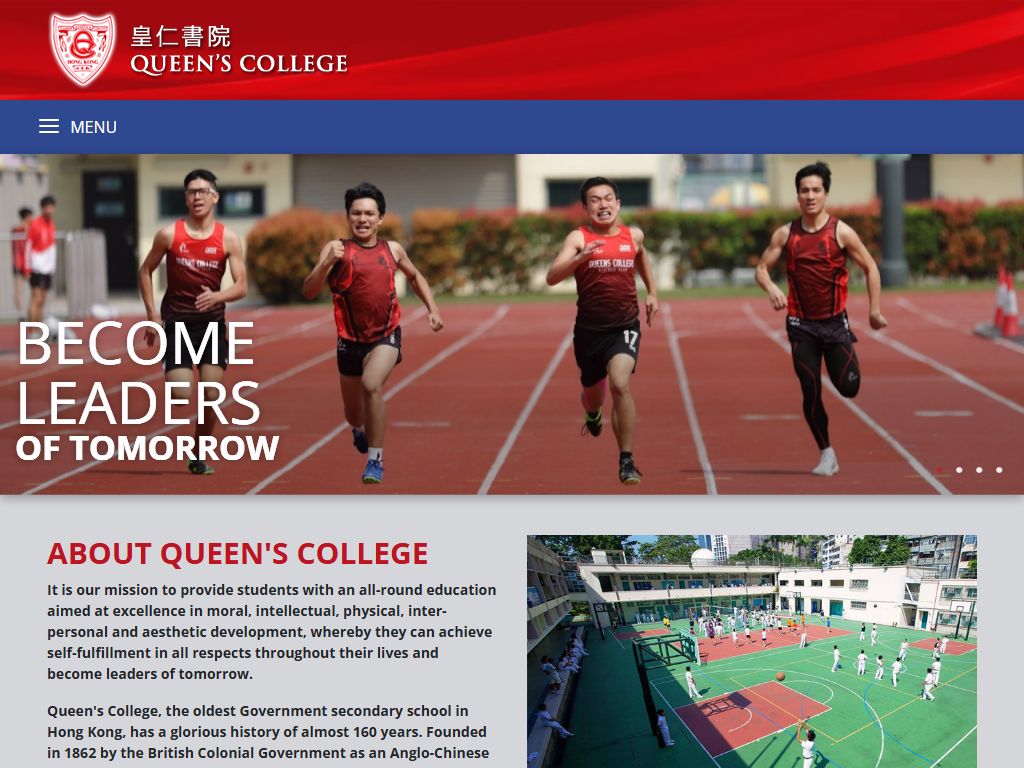
It is our mission to provide students with an all-round education aimed at excellence in moral, intellectual, physical, inter-personal and aesthetic development, whereby they can achieve self-fulfillment in all respects throughout their lives and become leaders of tomorrow.
📚 Approach & Strategies
Enabling QC boys to become self-regulated life-long learners is strategically implemented to promote the development of independent thinking, the spirit of exploration and innovation, creativity, and enhanced life competencies among students through subject-based activities inside and outside classrooms. Through effective questioning and timely feedback, students’ learning progress can be monitored and high-order thinking abilities can be systematically developed. The application of various e-Learning equipment, e-Learning platforms and training workshops can facilitate self-directed learning and build up students’ good learning skills. Moreover, students are encouraged to read extensively across various curricula and contexts to enhance their language proficiency and self-learning abili…
💛 SEN Support
Our School is committed to developing an inclusive and caring culture through the “Whole School Approach”, providing students who have special educational needs (SEN) with diversified supporting services to enhance their learning efficacy. The Student Support Team consists of the following members: The Principal, Vice Principals, Special Educational Need Coordinator (SENCO), teachers-in-charge of Curriculum Development, Counselling, Careers and Life Planning, Examinations, and teachers trained in special education, school social workers and teaching assistants. Training for teachers on supporting students with SEN is provided by SENCO and Educational Psychologist (EP). The Learning Support Grant and other resources are fully utilized for recruiting teaching assistants, purchasing services…
🎨 Whole-person Learning
Extra-curricular activities are an important part of school life at Queen’s College. Through organising and participating in a wide range of activities, our students gain valuable learning experiences that foster independence and resilience. Queen’s College offers a broad array of extra-curricular options, including the Student Council, eight Houses, and 47 clubs and societies. To cultivate strong relationships among students across different year levels, the House system has been in place since the 1950s. Inter-house competitions are held at the annual Athletics Meet, Swimming Gala, and other events. Each House’s performance is recorded, and an Overall Championship is awarded each year. Every club has teacher advisors, while students take on leadership roles such as chairman, vice-chairm…
📋 School Data
All raw fields from the Education Bureau school profile not shown above.
| title_supervisor_chairman_of_mc | Mr. |
|---|---|
| title_of_principal | Mr. |
| principal_qualifications_experiences | (B.Sc, PGDE) |
| imc | Not Applicable |
| training_compliance_rate_supervisor_managers_smc_chair_members | 67 |
| school_size | 16766 |
| sponsoring_body | Government |
| school_motto | Labor Omnia Vincit |
| parent_teacher_association | Yes |
| student_union_association | Yes |
| school_alumni_association | Yes |
| tsi_no_of_approved_teaching_posts | 52 |
| tsi_percent_of_received_teacher_training | 93 |
| tsi_percent_of_master_doctorate_or_above | 46 |
| tsi_percent_of_special_edu_training | 57 |
| tsi_percent_of_exp_0_4 | 18 |
| tsi_percent_of_exp_5_9 | 5 |
| tsi_percent_of_exp_10_or_above | 77 |
| 2025_2026_subject_offered_by_chinese_s1_to_s3 | Chinese Language, Chinese History, Putonghua |
| 2025_2026_subject_offered_by_english_s1_to_s3 | English Language, Mathematics, Science (S.1 to S.3), History, Geography, Computer Literacy, Visual Arts, Music, Physical Education, Citizenship, Economics and Society |
| 2025_2026_subject_offered_others_s1_to_s3 | - |
| 2025_2026_subject_offered_by_chinese_s4_to_s6 | Chinese Language, Chinese History (S.6) |
| 2025_2026_subject_offered_by_english_s4_to_s6 | English Language, Mathematics, Mathematics Extended Part Module 1, Mathematics Extended Part Module 2, Physics, Biology, Chemistry, History (S.5, S.6), Geography, Economics, Citizenship and Social Development, Business, Accounting and Financial Studies, Information and Communication Technology, Visual Arts (S.6), Music, Physical Education |
| 2025_2026_subject_offered_others_s4_to_s6 | - |
| 2026_2027_subject_offered_by_chinese_s1_to_s3 | Chinese Language, Chinese History, Putonghua |
| 2026_2027_subject_offered_by_english_s1_to_s3 | English Language, Mathematics, Science (S.1 to S.3), History, Geography, Computer Literacy, Visual Arts, Music, Physical Education, Citizenship, Economics and Society |
| 2026_2027_subject_offered_others_s1_to_s3 | - |
| 2026_2027_subject_offered_by_chinese_s4_to_s6 | Chinese Language, Chinese History (S.4) |
| 2026_2027_subject_offered_by_english_s4_to_s6 | English Language, Mathematics, Mathematics Extended Part Module 1, Mathematics Extended Part Module 2, Physics, Biology, Chemistry, History (S.4, S.6), Geography, Economics, Citizenship and Social Development, Business, Accounting and Financial Studies, Information and Communication Technology, Visual Arts (S.4), Music, Physical Education |
| 2026_2027_subject_offered_others_s4_to_s6 | - |
| current_year_no_of_class_s1 | 4 |
| current_year_no_of_class_s2 | 4 |
| current_year_no_of_class_s3 | 4 |
| current_year_no_of_class_s4 | 4 |
| current_year_no_of_class_s5 | 4 |
| current_year_no_of_class_s6 | 4 |
| sc_school_fee_s1 | - |
| sc_school_fee_s2 | - |
| sc_school_fee_s3 | - |
| sc_school_fee_s4 | - |
| sc_school_fee_s5 | - |
| sc_school_fee_s6 | - |
| sc_tong_fai_s1 | - |
| sc_tong_fai_s2 | - |
| sc_tong_fai_s3 | - |
| sc_tong_fai_s4 | - |
| sc_tong_fai_s5 | - |
| sc_tong_fai_s6 | - |
| sc_pta_fee | $100 |
| sc_student_union_association_fee | $20-$50 |
| sc_charges_for_non_standard_items | SMI fee: $150 |
| sc_others | $15 (replacement of student card) |
| sc_remarks | - |
| oa_s1_admission | Our school will accept discretionary places. Our school will participate in the Secondary School Places Allocation System through central allocation stage (Applicable for admission to S.1 in September 2026 ).Admission for the S1 discretionary places is based on students’ academic achievements and conduct (40%), performance in extra-curricular activities and services (15%), and performance in the interview (45%). Approximately 200 applicants will be invited for an interview on 7th March 2026. To acknowledge applicants’ achievements in areas other than academics, those with outstanding performance in music and/or sports will be separately selected for interviews. (Subject to the latest announcement in the school homepage at <a href="https://www.qc.edu.hk)" target="_blank" rel="noopener">https://www.qc.edu.hk)</a> |
| oa_orientation_activities_n_healthy_life | The Orientation Day and the Orientation Camp for the S1 students are organized at the end of August and September respectively. The Orientation Day takes place at the school campus. Being led by the group dads to participate in various games, the S1 students can know more about their seniors, schoolmates and the facilities of the school. It helps them adapt more easily to the new environment and the life in secondary school. The Orientation Camp takes place at the Po Leung Kuk Jockey Club Pak Tam Chung Holiday Camp. By participating in different experiential activities, the S1 students learn the importance of positive belief and attitude which can help them achieve their aims and establish a harmonious interpersonal relationship. Besides, the camp also helps to establish a close rapport between the seniors and the juniors and cultivate a sense of belonging of the students to their school. |
| school_management_url | https://www.qc.edu.hk/en/site/view?name=Organization+Chart |
| school_major_concerns_url | https://www.qc.edu.hk/uploads/files/School%20Plans%20and%20Reports%202526/1.%20Annual%20School%20Plan%202025-26.pdf |
| school_major_concerns | 1. To enhance students’ self-efficacy and agility in learning in the ever-changing world.<br>2. To enhance the holistic development of students and cultivate their growth mindset and a sense of morality. |
| school_organisation | The School Management Committee was formed to raise the quality and the effectiveness of education. Parents, alumni, teacher representatives and members of the community are encouraged to participate in decision making and school management. |
| imc_smc_mc | Chairperson:<br>Mr. TANG Kai-chak, Principal Education Officer (School Administration)<br>Members:<br>Mr. CHAN Cheung-wai Eric, Principal, Queen's College<br>Mr. Keating LEUNG Hay-ting, Alumni Member<br>Mr. CHAN Cheong-tak, Alumni Member<br>Mr. CHAN Hing-man, Parent Member<br>Ms. LEE Man-wai, Parent Member <br>Mr. WONG Hin-wing, Independent Member<br>Mr. KOO Chi-wa Chris, Teacher Member <br>Ms. CHAN Yuen-mei, Teacher Member |
| school_green_policy | In order to fulfil the mission of protecting the environment, our school is committed to ensuring that all of our management decisions, activities and routine operations are carried out in an environmentally-responsible manner. We will make information on environmental protection available to teachers and students and review our performance with regard to environmental protection regularly so as to improve our green campus management. |
| language_policy | All subjects are taught in English except Chinese Language, Chinese History and Putonghua. To improve students' language competence, training in all four skills - listening, speaking, reading and writing is emphasized. Students are also encouraged to participate in various language activities such as writing competitions, public speaking contests, debates and the Hong Kong School Speech Festival, so as to gain more opportunities to practise their language skills. All the morning assemblies held at school are conducted in English. There are also regular sharing sessions and presentations in English and Putonghua by the students in the assemblies. |
| school_based_curriculum | 1. Electives: 3X and 4X. HKDSE Electives: 3X, students can choose Music or Visual Arts as their 4X, depending on their ability.<br> 2. Curriculum highlights: Cross-curricular projects are arranged for junior forms for the systematic development of students’ generic skills. Striving to develop students' potential and fostering their creativity and high-order thinking skills, our school has developed a school-based gifted education curriculum in Mathematics. Moreover, the junior form Science curriculum has incorporated the 'Creative Science' module, which aims to encourage students to investigate scientific phenomena and apply STEAM education to solve daily life problems. |
| major_renewed_emphases_in_the_school_curriculum | Our school endeavours to facilitate students to acquire learner autonomy through E-learning, AI and STEAM education. Apart from participating in local and overseas AI and STEAM programmes, the school also encourages students to participate in AI and STEAM activities organized by local universities. Through the organization of seminars, leadership training camps and club activities, students are guided to understand the roles and responsibilities of leaders. In fact, many of our renowned alumni are frequently invited to share with students their experiences as leaders. |
| life_planning_education | The Career and Life Planning Team implements whole-school career and life planning programmes. Through talks, workshops, visits, mock practices, mentorship programmes, job shadowing and internship programmes, etc. jointly organized with local and overseas universities, local companies, non-government organizations and Queen's College Old Boys' Association, our students are provided with ample opportunities to explore the knowledge, skills and attitudes conducive to career and life planning. |
| whole_school_approach_cater_for_learner_diversity | Queen’s College has adopted the three-tier operation mode suggested by the Education Bureau in implementing gifted education. In tier 1, we have used pedagogy that could tap the potential of students in creativity, critical thinking, problem solving or leadership in the regular classroom by providing curriculum enrichment content in class. In tier 2, we have offered pull-out programmes after regular school hours, for instance, QC Mathematics Olympiad training sessions, Chinese / English Debate team training sessions. In tier 3, students are enrolled in local and international competitions and various programmes offered by local universities every year. |
| support_for_non_chinese_students | Our school provides additional support for NCS students to facilitate their learning of Chinese: appointing additional teacher(s)/teaching assistant(s) to support NCS students’ learning of Chinese; arranging intensive Chinese learning and teaching mode(s), e.g. pull-out learning if necessary, split-class/group learning, etc.; developing school-based Chinese Language curriculum and/or adapting learning and teaching materials; and organising activities to create an inclusive learning environment in the school. |
| adaptation_for_learning_and_assessment | In both the first term and the second term, there are one uniform test and one examination, which account for 10% and 90% of the total score for each term respectively. The annual final score is calculated by combining one-third of the Half-yearly Examination total score and two-thirds of the Yearly Exam total score. Coursework grades are also given to reflect primarily the students’ performance in regular quizzes, assignments, and classroom activities. |
| home_school_co_operation_url | -<a href="https://qc.edu.hk/qcpta/tc/" target="_blank" rel="noopener">https://qc.edu.hk/qcpta/tc/</a> |
| home_school_co_operation | Family upbringing and school education have always formed the cornerstone of child development, and hence good communication and correspondence between parents and teachers are essentially important. Established in 1989, the Queen’s College Parents-Teachers’ Association (QCPTA) performs the function of facilitating said co-operation. Since its establishment, the QCPTA has regularly enlisted the help of parent volunteers to organize events such as community service activities, parents’ talks, Teachers’ Day celebrations, dumpling-making workshops, Open Day bazaars, parent-child trips, briefing sessions for new S.1 parents, Parents’ Blood Donation Day, overseas university talks, used book sales and basketball friendly matches. We sincerely express our gratitude towards parents’ active participation and unwavering support. We also give our special thanks to our parent volunteers who made every event a fulfilling one for teachers, students and families. In the coming year, the QCPTA hopes to continue to leverage the support of parents to maximize home-school co-operation, and improve the learning environment and family lives of Queen’s College students. |
| school_ethos | Our school focuses on the whole-person development of the students as well as the five core values, namely Diligence, Brotherhood, Integrity, Responsibility and Pursuit of Excellence, in order to groom students to become future leaders. Diligence reminds our students to be hardworking. Brotherhood indicates the hope that our students treasure their friendship and are willing to help each other. In fact, many graduates participate actively in various school functions to provide support to the students. In recent years, a 'mentoring scheme' has been established, in which alumni of various professions offer work-related learning experiences to the students and provide guidance and advice for their career and life planning. Integrity and Responsibility are values that our students are expected to possess and are reflected in their behaviour. Pursuit of Excellence is the goal of each of our students. They are always eager to improve themselves and strive for the best. All in all, our students are self-disciplined and are ready to uphold the five core values of Queen’s College. |
| future_development_url | https://www.qc.edu.hk/uploads/files/School%20Plans%20and%20Reports%202425/5.%20School%20Development%20Plan%20202425-202627_edit.pdf |
| school_dev_plan | 2024/25 - 2026/27 School Development Plan<br>1. To enhance students’ self-efficacy and agility in learning in the ever-changing world.<br>2. To enhance the holistic development of students and cultivate their growth mindset and a sense of morality. |
| teacher_pro_training_and_dev | Our school places great emphasis on the professional development and training of teachers. We actively encourage all teaching staff to pursue further studies to enhance the effectiveness of teaching and learning. Each year, the school sets key focuses for teacher professional training based on its developmental goals and the needs of students. Teachers also proactively participate in courses, workshops, and seminars organized by the Education Bureau and other educational institutions to foster their professional growth.<br>The scope of professional development is diverse, encompassing areas such as self-directed learning, curriculum development, assessment literacy, student development, mental health, and parent education. The school also organizes e-learning seminars to better equip teachers with the skills needed to implement digital teaching and learning practices, thereby improving instructional effectiveness.<br>In addition, in-depth local cultural tours focusing on intangible heritage provide teachers with deeper insights into the transmission and evolution of local traditions. These experiences help educators understand the close developmental ties between the nation and the family. At the same time, such activities offer a relaxed environment for staff to share experiences and strengthen mutual understanding, which contributes to building team consensus and enhancing overall work efficiency. |
| fac_no_of_classroom | 30 |
| fac_school_facilities | Gymnasium, Hall, Student Activity Centre, Campus Wi-Fi and Internet facilities, 3 E-learning classrooms, 2 Computer Rooms, Visual Arts Room, 5 Laboratories, 2 Playgrounds, Library, Lecture Theatre, Conference Room, History Museum, History Corridor, Interview Room, Discipline and Counselling Room and Social Workers Room. |